-
Your Rights
Title
- About us
- Partnership
- Help


 Română
 Italiano
 Deutsch
 Français
 Nederlands
 Español
 Português
 Magyar
 Polski
 Shqip
Shqip
 Български
 Čeština
 Русский
 Dansk
Dansk
 Ελληνικά
 Lietuvių
 Македонски
 Norsk
Norsk
 Slovenščina
 Српски
 Svenska
 Հայերեն
 Eesti
Eesti
 Türkçe
 Slovenčina
 Українська
 Latviešu
 Suomeksi
- My flight was cancelled
- My flight was delayed
- I missed my connecting flight
- I was denied boarding
- My flight was overbooked
- My flight was advanced
- My flight was diverted
- About us
- Partnership
- Help
 Română
 Italiano
 Deutsch
 Français
 Nederlands
 Español
 Português
 Magyar
 Polski
 Shqip
Shqip
 Български
 Čeština
 Русский
 Dansk
Dansk
 Ελληνικά
 Lietuvių
 Македонски
 Norsk
Norsk
 Slovenščina
 Српски
 Svenska
 Հայերեն
 Eesti
Eesti
 Türkçe
 Slovenčina
 Українська
 Latviešu
 Suomeksi
- Sign In Claim compensation
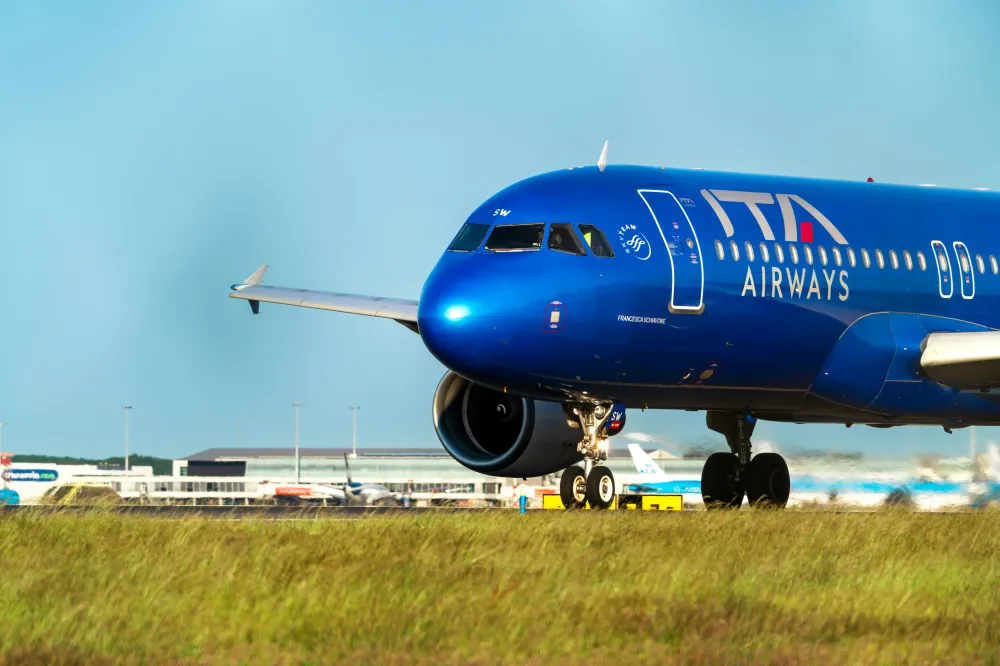
So your flight with ITA Airways – Italy’s new national carrier – didn’t take off on time. First off, don’t panic! ITA Airways (Italia Trasporto Aereo) started flying in late 2021 as the successor to the old Alitalia airline. It’s still growing into its wings, so occasional delays happen. Before you groan and text your friends “SOS stranded in Rome,” let’s go through what this means and what you can do about it – from understanding your rights to snagging up to €600 back.
Meet ITA Airways
ITA Airways is essentially the new Italian flag carrier. It was founded in 2020 as the replacement for the bankrupt Alitalia. It took over Alitalia’s colors and routes, and started actual flights on 15 October 2021. Today ITA flies to many destinations across Europe, plus some long-haul routes. Because it inherited Alitalia’s fleet and staff, many travelers still affectionately (or not-so-affectionately!) call it “the new Alitalia.”
Being a relatively new airline means ITA is still ironing out kinks. In practice, though, ITA Airways is an EU-based carrier. That’s great news: if your ITA flight is delayed in Europe, EU passenger rights apply to you. We’ll cover those rights in a bit.
Why Flights Get Delayed
A few minutes’ wait in an airport lounge can feel like forever – especially if nobody tells you why. Flights with any airline (including ITA) can be delayed for many reasons. Here are some common ones to keep in mind:
Weather issues: Europe’s climate can be unpredictable. Heavy fog, thunderstorms, snow in the Alps or even summer storms around Mediterranean airports can ground flights or make traffic control cautious. Blame mother nature.
Air traffic control congestion: Major hubs like Rome or Milan can get busy. If too many planes want to land or take off, ATC may space them out. Also, sometimes neighboring countries’ airspace or strikes can jam traffic.
Technical or maintenance glitches: Planes need regular checks. If an ITA aircraft has a mechanical snag, even a minor one, it must be fixed before flying. Safety first, of course. This can add minutes or hours.
Crew and staff schedules: Flight crews (pilots and flight attendants) have legal work-time limits. If an incoming flight is late, the crew might hit their maximum hours, forcing a delay or crew swap. Or ITA might be short-handed.
Late incoming plane: An aircraft that’s due to fly you might arrive late from a previous flight. When that happens, all subsequent departures get pushed back.
Airport-specific issues: Runway maintenance, airport security alerts, or even VIP movements (like military jets) can temporarily shut down airports.
Strikes and politics: Italy and Europe sometimes see strikes by air traffic controllers, baggage handlers, or even airline staff. Extra security or customs lines (during busy seasons or political summits) can also slow things down.
It can be frustrating, especially if your holiday or meeting is on the line. But remember: many of these factors (especially weather or technical issues) are usually considered “extraordinary circumstances.” Airlines can dodge compensation if they prove it truly couldn’t be avoided. That said, not every delay is out of anyone’s control.
Know Your Rights: EU Compensation (Regulation 261/2004)
Here’s the good news: since ITA is an EU airline and your flight is within (or to/from) Europe, EU Regulation 261/2004 applies. That means you might be owed compensation when things go wrong. In fact, EU rules say that if you arrive at your final destination 3 hours or more late and the delay wasn’t due to extraordinary issues, you deserve money back. How much? Depending on flight distance, between €250 and €600 per passenger.
Short flights (≤1500 km): €250 if you arrive 3+ hours late.
Medium (within EU >1500 km, or other flights 1500–3500 km): €400.
Long haul (>3500 km): €600.
The sweet spot (max €600) is for those long transcontinental hops. (Most ITA routes within Europe fall in €250–€400 range.) Also, if a delay reaches 5 hours or more, EU law says you can opt out and cancel the flight, getting a full refund of your ticket. This can be a great trick if an ITA flight will barely crawl at all – you could simply rebook on a different airline or mode of transport instead.
Importantly, the airline must offer you basic care while you wait. EU rules say during long delays they must provide meals, refreshments, and even hotel and transfers if needed. You won't always be told this, but keep an eye out: if the delay stretches on, politely ask an ITA agent for meal vouchers or accommodation. (Some travelers don’t realize it, but this “right to care” is real.) Always keep any receipts in case you pay for water or snacks – those might be reimbursable later.
Remember: “extraordinary circumstances” (like a sudden storm, volcanic ash, or war) can nullify compensation claims. But mundane delays – a quiet day’s technical issue, or an overbooked plane – still count as compensation-worthy.
Flight Delayed ITA Airways: What To Do Next
Okay, your ITA flight is late. You’ve got questions: What should I do? Am I stuck? Can I get home on time? Let’s lay out some friendly step-by-step advice:
1. Talk to the airline staff calmly. Head to the ITA Airways desk or gate counter. Ask them what happened and what they’re doing. Are they rebooking you on the next ITA flight? Will there be meals or hotel if it’s an overnight? Being polite here can really help. Often, agents can squeeze you onto standby for an earlier flight or at least confirm your new departure time.
2. Know your immediate rights. If the delay is a few hours, the airline should give you snacks or vouchers. If it turns into an overnight delay, you should be put up in a hotel at no extra cost (especially if it’s EU leg). If they don’t offer, you can gently remind them of EU rules (sometimes it jogs their memory!). Always keep evidence: photos of departure screens, boarding pass stubs, and any emails about the delay. This will help later if you make a claim.
3. Check alternative travel options. While waiting, it doesn’t hurt to explore Plan B. Can ITA rebook you via another city? Are there flights with a different airline? Maybe the next train (if you’re going within Italy or nearby) is still on time and actually faster. For example, if you’re supposed to go Rome→Paris, maybe a fast train to Milan and flight from there could salvage the day. Also see if nearby airports have better flights (e.g. flying from or into Milan Linate vs. Malpensa, or Venice as an option).
Alternate flights: Use your phone to scan flight apps or airline sites. Sometimes, self-rebooking on a different carrier is allowed (or at least worth asking the agent about).
Trains in Europe: Remember, Europe’s rails are excellent. Rome–Florence–Milan is a breeze by high-speed train. If your delay isn’t too long, a train might get you there instead of sitting at the airport.
Other airports: If Rome-Fiumicino is a mess, see if a train to Milan or Venice for a flight helps. (Yes, it adds travel, but if your wait is many hours, it could even be faster.)
Being a bit proactive can turn a total knock-out delay into a minor reroute.
4. Claim your compensation. After you finally arrive (whether it’s the next day or with another flight), it’s time to claim. Under EU law you can file for that €250–€600 compensation. You’ll need flight details (dates, numbers) and any evidence of the delay (boarding passes, delay notifications, receipts for expenses). You can do this on your own by emailing ITA’s customer service, but it can be a bit of a paperwork fight. This is where a service like Trouble Flight can step in (more on that below). They can handle the emails and keep track of deadlines so you don’t have to.
By following these steps, you make the best of a messy situation. And even if your trip ended up a few hours or days later, you won’t feel like you totally lost out – you’ll get something back.
Quick Tips & Hacks
Document everything: Take a photo of the departure board showing the delay, or get a written notice from the gate staff. These help prove your delay later.
Ask for meals or accommodation: Even if you’re at the airport for a while, find an agent and ask what’s provided. You might not be reminded, so it’s worth checking.
Look up EU 261 rules online: Being aware of your rights (like the 5-hour cancellation rule) gives you power. A quick search on your phone can arm you with facts if needed.
Stay flexible: Sometimes a minor extra expense (like a train ticket or switching to a different airport) can save hours. Think “what’s the fastest way to get close to my plan.”
Travel insurance? If you have it, see what delays coverage it provides. Though often it just covers meals and minor expenses, not the big €600 compensation.
Why Trouble Flight Can Help
Dealing with airlines (especially after a trip is over) can be a real drag. That’s why many travelers turn to a claims specialist like Trouble Flight. Trouble Flight is a no-nonsense, no-win-no-fee service that handles all the annoying legwork for you. Here’s how it works:
Hassle-free: You tell them your flight details and what happened. Trouble Flight has a team that then contacts ITA Airways for you, fills out claim forms, and negotiates on your behalf. You don’t have to drown in bureaucracy.
No upfront cost: You only pay Trouble Flight if they successfully get money for you. It’s a no-win, no-fee deal. If they don’t get you compensated, you pay nothing.
Transparent fee: If you do win, Trouble Flight takes a commission of 25% of the compensation (plus VAT). That means if you got €400 back, Trouble Flight’s fee would be €100 plus VAT. If your case goes to court (extremely rare, but possible) and they have to sue the airline, the fee becomes 50% (incl. VAT). Still, you only pay after you get paid, so it’s risk-free for you.
Experienced with EU law: They know the ins and outs of Regulation 261/2004, so they catch things you might miss (like combining multiple legs of a trip, or calculating correct delay time).
Covers all scenarios: Trouble Flight isn’t only for delays. They can also help if your ITA flight was cancelled, if you were denied boarding due to overbooking, or if you missed a connecting flight and arrived hours late. Basically, if EU law says you’re owed compensation or assistance, Trouble Flight can handle the claim.
In short, using Trouble Flight is like hiring a friendly expert to fight the airline for you while you relax. They often have great reviews from customers who thought “Yes, my flight was a pain – glad someone took care of this.” They even note on their site that travelers can claim compensation up to €600 per passenger. (Not every traveler knows that!)
Key thing: when you win compensation, the airline pays that money. Trouble Flight’s commission is taken from that payment, not from your pocket. Think of it as paying a familiar share in exchange for a lot of heavy lifting done for you.
Other Travel Troubles (Cancellations, Overbooking, Missed Connections)
While we’re here, a quick word on other flight issues. The same EU 261/2004 rules broadly apply:
Cancelled flights: If ITA cancels your flight entirely (with little notice), you’re also entitled to compensation and a choice of reimbursement or re-routing. Again, Trouble Flight can claim that for you too.
Denied boarding (overbooking): Airlines often overbook flights. If you had a confirmed ticket and ITA asks you to give up your seat (or refuses you), you may claim compensation under the same €250–€600 scale, plus re-routing assistance.
Missed connections: If you booked ITA flights as a single itinerary and a delay made you miss a connecting flight (especially one on the same ticket), that’s typically treated like a delay for the overall journey. You may qualify for compensation for the extra delay at your final stop.
The great thing (for you) is that Trouble Flight can handle all these scenarios. You don’t have to juggle different forms or worry which rule applies. If you have a bump in your travel – delay or otherwise – they can usually help sort compensation or refunds in any of these cases.
Conclusion
We know having an ITA Airways flight delayed is a headache. But hopefully this guide makes it a bit less painful. You’re not just stuck eating airport sandwiches in silence – you have rights! EU regulations are on your side, and you could walk away with up to €600 per passenger if your arrival was 3+ hours late (and if it drags on 5+ hours, remember you could even cancel and refund the ticket). Meanwhile, airlines are supposed to look after you in the meantime with food and care.
If dealing with all this sounds like too much, remember: Trouble Flight exists to make it easy. Think of them as your delay-fighting sidekick – they speak the airline’s language so you don’t have to. They work on “no win, no fee” terms, only charging a portion of any payout. It takes the stress out of the situation.
So next time you find yourself waiting at an ITA gate, keep in mind: this isn’t just a waiting room, it’s a bit of leverage! Stay calm, use the tips above, and if you’d rather not navigate the claim on your own, let Trouble Flight handle it in the background. Safe travels – and may your future flights be on time (but if not, you know what to do)!
Read also
- Flight Delayed Timișoara
- Flight Overbooking in Grosseto – Know Your Rights & Claim Compensation
- Flight Cancelled Brussels Airlines – What To Do, Your Rights & How To Get Compensated
- Flight Delayed Brussels Airlines – What Now? Here’s What You Can Do
- What to Do If Your Flight in Stavanger Is Delayed
- How Long Can Airlines Delay Your Flight?
What our customers say about us