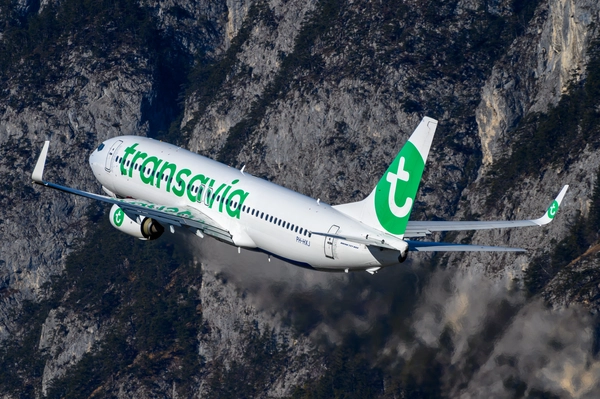
Transavia
On this page
- When Does Transavia Owe Flight Delay Compensation?
- How Much Compensation Can You Claim from Transavia?
- Airline Operational Faults vs. Extraordinary Circumstances
- Your Right to Care and Assistance at the Airport
- What If Your Departure Is Delayed by 5 Hours or More?
- Missed Connecting Flights and Self-Transfers
- What Evidence Should You Collect at the Airport?
- How Trouble Flight Helps You Claim Transavia Compensation
- Other Transavia Disruption Rights
- Frequently Asked Questions
If your Transavia flight arrived at your final destination 3 hours or more late, you may be entitled to cash compensation between €250 and €600 under European passenger rights laws. Whether you flew with Dutch operator Transavia Airlines (IATA code HV) or French subsidiary Transavia France (IATA code TO), your rights are protected whenever your flight departs from an airport in the European Union or arrives in Europe on an EU airline.
When a flight delay disrupts your schedule, claiming what you are owed should not be complicated. You can check your eligibility with Trouble Flight to see if your disruption qualifies for compensation and let our legal team handle the claim on your behalf.
When Does Transavia Owe Flight Delay Compensation?
Under EU Regulation (EC) No 261/2004, passengers on delayed Transavia flights have clear statutory rights. Because Transavia Airlines and Transavia France are both EU-licensed carriers based in Member States (the Netherlands and France), EU261 protection applies broadly across their entire network—including routes operating between Europe, North Africa, and the Middle East.
To qualify for fixed financial compensation, your delay must meet specific legal criteria:
- Arrival delay of 3 hours or more: The delay is measured at the moment the aircraft arrives at your final destination gate and at least one cabin door is opened for passenger disembarkation, not when the plane touches down on the runway.
- Airline responsibility: The disruption must be caused by factors within the airline's operational control, such as mechanical issues, technical faults, crew scheduling delays, or aircraft rotation problems.
- Valid reservation: You held a confirmed booking and checked in on time according to the airline's standard deadlines.
If your disruption involved a cancellation rather than a delay, see our dedicated guide on Transavia cancelled flights for full details on refund and rerouting rights.
How Much Compensation Can You Claim from Transavia?
The compensation amount for a delayed flight under EU261 depends on the total flight distance of your journey rather than the price of your ticket. For flights departing from the UK, equivalent amounts apply under UK261 regulation.
| Flight Category / Distance | Delay at Final Destination | Fixed Compensation |
|---|---|---|
| All flights up to 1,500 km | 3 hours or more | €250 |
| Intra-EU flights over 1,500 km | 3 hours or more | €400 |
| Non-intra-EU flights between 1,500 km and 3,500 km | 3 hours or more | €400 |
| Non-intra-EU flights over 3,500 km | 3 hours or more | €600 |
It is important to note that long intra-EU flights—such as Transavia services from Amsterdam or Paris to the Canary Islands—remain capped at €400 even when the total distance exceeds 3,500 km, as required by EU law.
Airline Operational Faults vs. Extraordinary Circumstances
Transavia is required to pay statutory compensation unless the delay was caused by extraordinary circumstances that could not have been avoided even if all reasonable measures had been taken.
Delays Eligible for Compensation
Airlines are directly responsible for managing their fleet and operational staffing. The following situations are generally eligible for financial compensation:
- Technical breakdowns: Routine mechanical failures, aircraft maintenance issues, or unexpected equipment repairs required before takeoff.
- Crew operational issues: Crew shortages, flight attendant roster errors, or pilots exceeding mandatory flight-duty time limits.
- Aircraft rotation delays: Late arrival of the aircraft from a previous flight leg due to airline scheduling decisions.
Extraordinary Circumstances (No Compensation Owed)
Transavia is exempt from paying cash compensation if the disruption was strictly caused by factors outside its control, such as:
- Severe, unannounced weather conditions making flight operations unsafe (e.g., severe blizzards, dense fog, sandstorms).
- Air traffic control (ATC) slot restrictions, flight space closures, or national ATC strikes.
- Airport security emergencies, political instability, or bird strikes during takeoff/landing.
Even when extraordinary circumstances prevent cash compensation, Transavia remains legally obligated to provide care and assistance at the airport.
Your Right to Care and Assistance at the Airport
When your Transavia flight suffers a significant departure delay, the operating carrier must provide care and assistance free of charge while you wait. The threshold for receiving care depends on flight distance:
- 2 hours or more: For flights up to 1,500 km.
- 3 hours or more: For intra-EU flights over 1,500 km and other flights between 1,500 km and 3,500 km.
- 4 hours or more: For non-intra-EU flights over 3,500 km.
Under statutory care rights, you are entitled to:
- Free meals and refreshments proportional to the waiting time (often distributed as airport vouchers).
- Two free telephone calls, emails, or faxes to notify contacts of your delay.
- Free hotel accommodation and airport-to-hotel transport if the delay requires an overnight stay.
Receiving airport refreshment vouchers or hotel lodging does not waive or reduce your right to cash delay compensation.
What If Your Departure Is Delayed by 5 Hours or More?
If your Transavia flight is delayed at departure by 5 hours or longer, you gain additional statutory rights under EU261. You can choose not to travel and request a full refund of your ticket price within 7 days, along with a return flight to your initial point of departure if you are mid-journey.
If you decide to cancel your flight because of a 5-hour departure delay, you can still seek financial delay compensation if the root cause was within the airline's control.
Missed Connecting Flights and Self-Transfers
Transavia operates primarily as a point-to-point airline, but passengers frequently book connecting flights. Your legal protection depends on how your tickets were issued:
- Single Reservation: If your journey was booked under a single booking reference (such as a codeshare or single-ticket connection with sister carrier KLM or another Transavia leg) and an initial delay causes you to miss a connecting flight, compensation is evaluated based on your arrival delay at the final destination.
- Separate Tickets (Self-Transfer): If you booked separate tickets independently, each flight leg is legally distinct. A delay on your first Transavia flight will not make the airline legally liable for missed onward flights booked on a separate ticket.
To review overall rights across all travel situations, read our complete guide on Transavia flight compensation or check rights for sister carrier delays with KLM delayed flight compensation.
What Evidence Should You Collect at the Airport?
To build a strong case for compensation, gather the following documentation before leaving the airport or accepting alternative transport:
- Boarding Passes and Booking Confirmation: Keep electronic or paper boarding passes containing your flight numbers (HV or TO) and booking reference.
- Timestamped Disruption Notices: Take photos or screenshots of departure board screens, SMS text alerts, or email notifications showing the flight delay.
- Record Actual Arrival Time: Note the exact time the aircraft doors opened upon arrival at your destination gate.
- Expense Receipts: Retain detailed receipts for out-of-pocket expenses (meals, drinks, taxi fares, accommodation) incurred because care was not provided by the airline.
How Trouble Flight Helps You Claim Transavia Compensation
Airlines often decline valid passenger claims by citing general operational issues or unverified weather events. Trouble Flight simplifies the compensation process by evaluating your disruption against real-time flight tracking data, weather reports, and European legal precedents.
Our team verifies whether Transavia Airlines or Transavia France was the operating carrier, handles all legal filings, and pursues the compensation you are owed. You can submit your claim with Trouble Flight in just a few minutes and let experts handle the dispute on your behalf.
Other Transavia Disruption Rights
Flight delays are not the only disruptions covered under European air passenger laws. If your journey was impacted in other ways, explore your rights here:
- If your flight was oversold or you were turned away at the gate, see our advice on Transavia flight overbooking and general rules for when you are denied boarding or when a flight is overbooked.
- If your journey was cancelled entirely, read our guide on cancelled flights.
- Comparing European low-cost carriers? Check our guides for delayed Vueling flights and other European airlines.
Frequently Asked Questions
How long do I have to claim compensation for a delayed Transavia flight?
The deadline to file a flight delay claim depends on the national law of the country where the claim is brought. For example, claims handled under Dutch law generally have a 2-year limitation period, whereas claims under English law have up to 6 years, and German law allows 3 years. Because time limits vary, it is best to check your claim as soon as possible after the delay.
Can I claim compensation if Transavia gave me food vouchers at the airport?
Yes. Meal vouchers, drinks, and hotel stays fall under your statutory right to care and assistance. Accepting airport vouchers or care does not replace or reduce your right to monetary compensation under EU261.
How is the arrival delay time officially defined?
In accordance with European Court of Justice rulings (Case C-452/13), arrival time is defined as the moment when at least one of the aircraft's doors opens and passengers are permitted to leave the plane. Touchdown time on the runway does not count as the official arrival time.
Does EU261 apply to Transavia flights returning to Europe from non-EU countries?
Yes. Because both Transavia Airlines (HV) and Transavia France (TO) are EU-licensed air carriers, EU261 applies to all their flights departing from EU airports as well as all inbound flights departing from non-EU airports (such as Morocco, Tunisia, Egypt, Turkey, or Dubai) arriving back into an EU destination.